
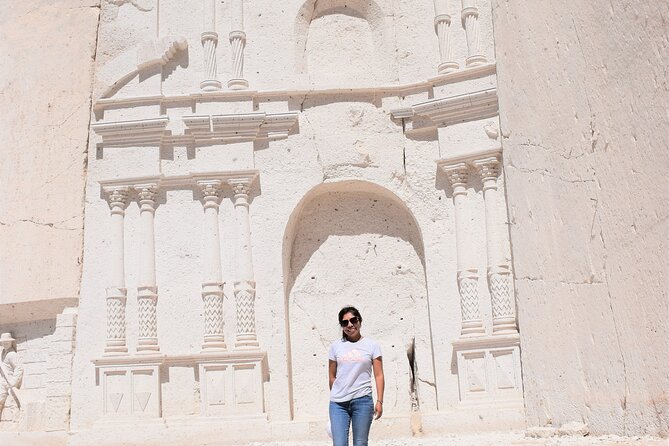
Reviewed · SILLAR ROUTE & AREQUIPA COUNTRYSIDE
Sillar Route and Culebrillas Petroglyphs
Arequipa’s white volcanic stone is more than a building material. It gives the city its pale colonial look, and this half-day outing takes you to the quarries where sillar is still worked by hand. You’ll also walk through the narrow Culebrillas canyon, where faint petroglyphs mark the rock walls.
I like the low price and the chance to see a working quarry rather than only admiring finished buildings downtown. I also like the Yanahuara viewpoint, with its classic view of Misti, Chachani, and Pichu Picchu. The main caution is that the canyon walk is dusty, uneven, and not ideal for older adults or anyone with a dust allergy.
Key points to know before you book
- Sillar is still worked by hand: Local builders explain how Arequipa’s signature white volcanic stone is cut and used.
- Culebrillas is the best walking stop: The 20-minute canyon walk passes curving rock walls and petroglyphs, followed by a short uphill section.
- Yanahuara gives you the classic volcano view: You’ll see the city from its famous ashlar arches, weather permitting.
- The tour lasts about four hours: Much of that time includes transfers, including roughly 40 minutes on the return to central Arequipa.
- Dust is a real issue: Bring a face mask, water, closed shoes, and protection for exposed skin.
- Guide quality can vary: Guides including Mike, Alexandra, Christina, and Sandra have been praised for clear bilingual explanations, while fast English delivery has caused problems for some participants.
Why the sillar route matters in Arequipa
Arequipa is often called the White City because so many of its historic buildings were made from sillar, a pale volcanic stone formed from ash and rock. The material is soft enough to cut, yet durable enough for churches, mansions, courtyards, and decorative arches.
The tour helps you connect the stone in the city center with the people and work behind it. Instead of treating Arequipa’s architecture as a pretty backdrop, you see where the material came from and how local craftspeople shaped it.
At $19 per person, this is one of the cheaper ways to get outside the city for several hours. The price includes a certified guide, group transport, and the two listed entrance fees, S/5 for Añashuayco and S/5 for Culebrillas. You should still budget for personal expenses, and some extra sculptural areas may require small additional payments depending on the route used that day.
The low cost comes with trade-offs. This is a shared tour for up to 18 people, so pickup can take time and explanations may be given in both Spanish and English. Most of the route is straightforward, but the experience is not a private or highly tailored excursion.
Other trips into the countryside from Arequipa:
- From Arequipa: Sillar Route Trek
★ 4.2 · 461 reviews - Sillar Route in Arequipa and viewpoint of the Volcanoes
★ 4.0 · 71 reviews - 4 hours Tour: Route of Sillar with Trek in Culebrillas
★ 4.2 · 69 reviews
Yanahuara and the three volcanoes
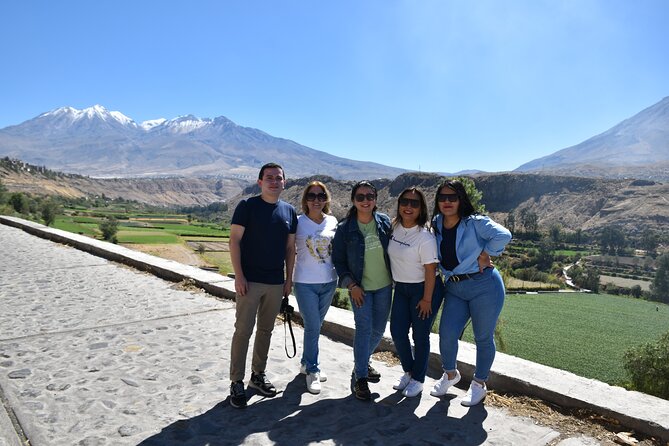
The first stop is Yanahuara, a traditional district just outside central Arequipa. Its viewpoint is framed by the famous sillar arches, which make a strong foreground for photographs of the city and surrounding peaks.
You’ll usually spend about 20 minutes here. That is enough for pictures and a quick orientation, but not enough for a long visit. Some departures have spent less time at the viewpoint when traffic delayed the pickup, so do not count on a leisurely stroll through the district.
From the arches, the main sights are Misti, Chachani, and Pichu Picchu. Clear weather gives you the best chance of seeing their snowy summits, although haze can reduce the view later in the day. If the volcanoes are a priority, ask about the expected timing and try to keep your camera ready.
This stop is useful even if you have already explored Arequipa’s center. It places the city’s white buildings in a broader setting and gives you a quick sense of the region’s volcanic character. It is also the least active part of the outing, so it suits anyone who wants a scenic start before the quarry and canyon walks.
Añashuayco quarry and the people behind the stone
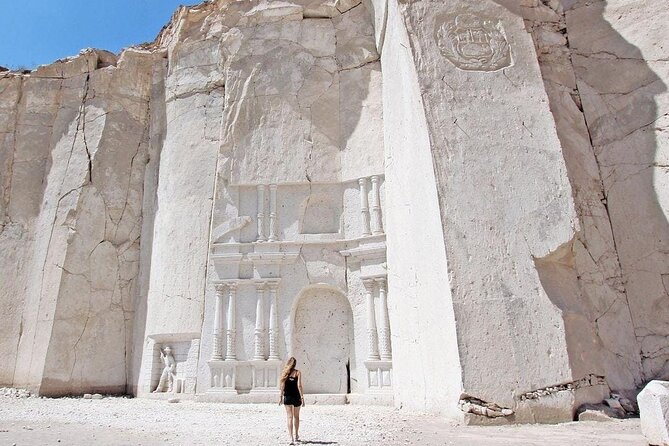
The main quarry visit lasts about one hour. Here you’ll see the pale walls of the quarry and the raw blocks of sillar used in Arequipa’s construction. Local workers explain cutting methods, shaping techniques, and the many ways the stone is used.
The quarry is not a polished museum. Expect dust, sun, rough ground, and an active working area. That is part of its value, but it also means the quality of the visit depends heavily on how much explanation your guide provides.
Some guides have made the stop especially strong by explaining the connection between quarry work and Arequipa’s churches and colonial buildings. Mike, Alexandra, Christina, and Sandra have each been noted for friendly bilingual guiding on different departures. With other guides, the visit may feel more like free time to walk around than a structured lesson.
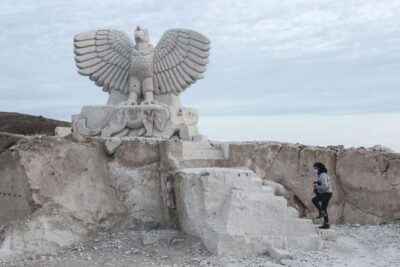
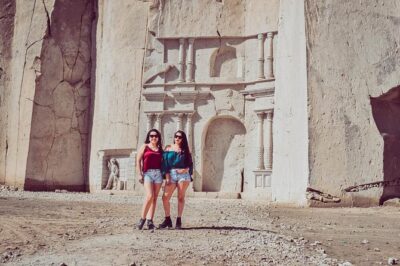
The site includes carved figures and stone sculptures that make good photographs. Be aware that the quarry area can be larger than the portion included in a short visit. Some of the most striking sculptures may sit in sections with small extra entrance charges, and you may not have time to see every display.
Dust is the practical issue here. Bring a face mask, especially if you have allergies or sensitive lungs. A scarf or buff can help too, but the supplied information specifically warns against this outing for anyone with a dust allergy. Wear shoes with a firm sole, since the ground is not designed for easy walking.
Walking through Culebrillas canyon
After the quarry, the vehicle continues for about 15 minutes to the Culebrillas area. This is the most memorable part of the tour for many people, and it feels quite different from the open quarry.
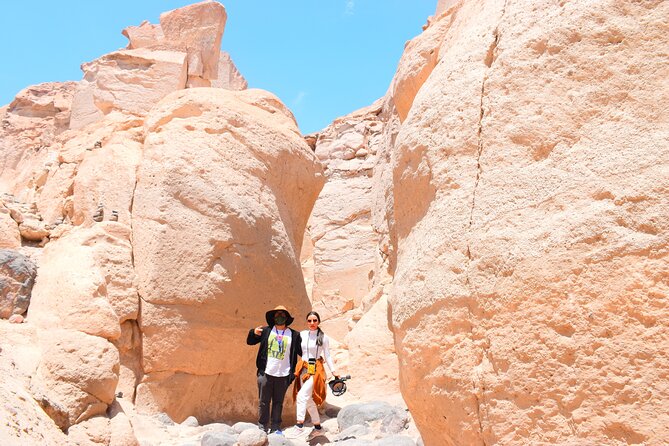
The canyon is a narrow, winding passage shaped by an ancient river. Its curved walls create unusual lines and shadows, and the roughly 20-minute walk gives you a close look at the volcanic rock. The route is short, but it is not a smooth city path.
You may need to step over uneven ground and manage a brief five-minute uphill section. Good grip matters. The walk is described as easy to moderate, but the surface can feel awkward if you are unsteady, wearing sandals, or trying to take photographs while moving.
The petroglyphs are carved into the canyon walls. They are not always easy to see. Bright midday sun can wash out the markings, and the images require imagination because the figures are faint and weathered. You might make out animal shapes, but do not expect large, sharply defined drawings.
Your guide’s explanation matters most here. A good bilingual guide can point out the markings and explain the local meaning of the site without turning the walk into a rushed photo stop. Guides such as Alexandra and Sandra have been praised for giving English speakers individual attention, while fast or unclear English delivery has made the canyon harder to follow for others.
At the end, you’ll see apachetas, small stone mounds connected with local spiritual tradition. They are simple, but they add a cultural layer to the canyon visit. Treat them as a living tradition rather than a prop for climbing or rearranging.
The canyon can also have insects, including sand flies. Advice has sometimes focused on mosquito repellent, but protection from biting insects is still sensible. One practical lesson is to bring repellent you already know works for you rather than relying on a last-minute recommendation.
Same base, a completely different day:
- From Arequipa: Colca Canyon Full-Day Guided Tour with Meals
★ 4.5 · 982 reviews - Tour to the Salinas Lagoon and National Reserve in Arequipa
★ 4.5 · 548 reviews - Arequipa: Chili River White Water Rafting with Hotel Pickup
★ 4.8 · 329 reviews - From Arequipa: 2-Day Colca Canyon Trekking Tour
★ 4.8 · 243 reviews
Transport, timing, and the shape of the day
Pickup is arranged from your hotel, with confirmation provided at booking. The vehicle is generally a group minibus, and the maximum group size is 18. Some departures have used comfortable air-conditioned vans, while others have had crowding or poor air circulation.
Pickup timing deserves patience. Collecting a full group can take around 30 minutes, and traffic in central Arequipa can cause longer delays. One departure began about 45 minutes late because of a city event, which shortened time at Yanahuara and the quarry. If you have a flight, another tour, or a fixed lunch booking, leave plenty of space afterward.
The planned return takes roughly 40 minutes from the Culebrillas area to central Arequipa. Drop-off arrangements need attention. The return may be to one central tourist stop rather than directly to your hotel, even though pickup begins at hotels. Confirm the exact return point before setting off.
Transport safety has also been uneven. Some passengers found the driver careful and appreciated seatbelts and safety equipment in the minibus. Others reported fast driving, rough roads, or an unavailable seatbelt in a front middle seat. If you are assigned a seat without a functioning belt, speak up before departure and ask to be moved.
Most of the drive is part of the cost of reaching the sites, not a scenic tour in itself. That is why this outing works best when you want a quick look beyond Arequipa rather than a slow, deeply detailed cultural day.
What to bring for a more comfortable visit
The basic packing list is simple, but each item solves a real problem:
- A face mask for quarry dust
- Water, since the route includes outdoor walking
- Closed shoes with good grip
- Sun protection for the open quarry and viewpoint
- Insect repellent for the canyon area
- A camera or phone with enough storage
- A light layer for changing conditions
Do not plan on wearing delicate clothing. White dust can settle on shoes, trousers, and bags. The canyon is also narrow, so a small day bag is easier to manage than bulky luggage.
Photography takes planning. At Culebrillas, bright light can make the petroglyphs difficult to capture, and the narrow path may be busy with other people moving in both directions. Listen carefully when the guide gives a meeting point, since unclear directions have caused confusion on some departures.
The bilingual guide makes a big difference
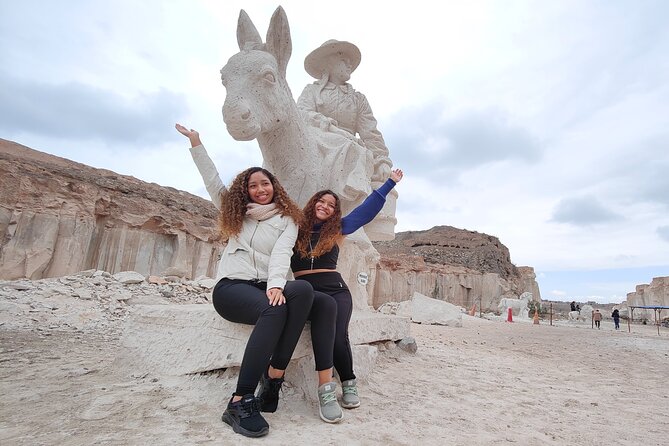
This is a bilingual group experience, and the guide can shape the entire day. The strongest departures have featured guides who explain the sites in both Spanish and English, answer questions, and keep the group together without rushing everyone.
Mike has been praised for clear English and Spanish explanations, while Alexandra, Christina, and Sandra have each been described as warm and effective guides on different outings. Tony has also been called entertaining and informative, though English delivery has not worked equally well for everyone.
If English is your only language, pay attention to the order of explanations. On a bilingual tour, the guide may speak first in Spanish and then in English, with free time beginning before every English detail has been covered. Politely ask the guide to slow down or repeat directions if needed.
This is especially important at Culebrillas, where the petroglyphs can be hard to identify without help. The quarry also benefits from context. Without an explanation of how sillar shaped Arequipa, the stop can feel like a dusty sculpture park rather than a meaningful look at local work.
Who should book this four-hour outing?
I would recommend it to first-time visitors with a spare half-day who want an easy way to see three different sides of Arequipa: city views, stone production, and a rugged archaeological site.
It suits people who enjoy short walks, unusual geology, local craft, and practical sightseeing. It is also a good budget choice if a private vehicle is outside your plans. The group size is manageable when the departure is well organized, and the included entrance fees keep the basic cost clear.
I would hesitate if you have a dust allergy, trouble walking on uneven ground, or very limited time in Arequipa. The quarry is dusty, the canyon is bumpy, and delays can reduce the time at each stop. It is not recommended for older adults who may find the Culebrillas section difficult.
The outing is also less suitable if you expect a quiet, detailed archaeological tour. The petroglyphs are faint, the visit is brief, and the route can feel rushed when traffic or late arrivals affect the schedule.
Should you book the Sillar Route and Culebrillas?
Book it if you want a low-cost half-day outside Arequipa and you are prepared for dust, shared transport, and a short rough walk. The quarry explains the material that gives Arequipa its character, while Culebrillas provides the most atmospheric stop and the best chance for a memorable walk.
Skip it if you need guaranteed timing, hotel-to-hotel service, a private guide, or easy paths throughout. Before booking, confirm the pickup time, English guiding arrangements, return location, and whether the departure includes all the sculptural areas you hope to see.
For most independent visitors, the value is solid. Just arrive ready for a working quarry, not a polished attraction, and let the canyon be the highlight rather than expecting dramatic, perfectly visible petroglyphs.
FAQ
How long does the Sillar Route and Culebrillas tour last?
The tour lasts approximately four hours, including transportation between Arequipa, Yanahuara, the quarry, Culebrillas, and the city center.
How much does the tour cost?
The listed price is $19 per person.
What is included in the tour price?
The price includes a certified guide, group transportation, the S/5 entrance to Añashuayco, and the S/5 entrance to Culebrillas.
Is hotel pickup provided?
Pickup from your hotel is provided. The return may be at a central tourist stop rather than directly at your hotel, so confirm the exact drop-off point.
How large is the group?
The tour can have a maximum of 18 participants.
Is the tour offered in English?
The tour is bilingual, with explanations in Spanish and English. Guides on different departures have included Mike, Tony, Alexandra, Christina, and Sandra.
Is the Culebrillas walk difficult?
The walk takes about 20 minutes and includes uneven, somewhat rugged ground. There is also a slope that takes about five minutes to climb. Good walking shoes are recommended.
Is this tour suitable for older adults?
It is not recommended for older adults because of the uneven walk in Culebrillas canyon.
Should I bring protection against dust?
Yes. The quarry can be dusty, and a face mask is a sensible item to bring. The tour is not recommended for people with a dust allergy.
Can I cancel for a full refund?
You can cancel for a full refund if you do so at least 24 hours before the experience begins. Cancellations or changes made less than 24 hours before the start time are not accepted for a refund.
Just added around Arequipa
- Adventure Day in Arequipa: Pillones Waterfall + Rock Forest★ 4.2 · 25 reviews
- From Arequipa: Pillones Waterfall and Stone Forest Day Trip★ 4.4 · 15 reviews
- Arequipa: Pub Crawl with Skip-The-Line Access and Drinks★ 3.0 · 4 reviews
- Arequipa: Walking Tour and Santa Catalina Monastery★ 4.4 · 7 reviews
- Arequipa Walking Tour and Santa Catalina Monastery★ 5.0 · 4 reviews
- Trekking, Waterfalls and Thermal Baths★ 4.5 · 47 reviews
- From Arequipa: Colca Valley & Thermal Baths Small-Group Trip★ 4.1 · 43 reviews
- Arequipa, Historic and Colonial City and Santa Catalina Monastery★ 4.5 · 42 reviews
Sillar Route & Arequipa Countryside, compared.
Sillar Route in Arequipa and viewpoint of the Volcanoes
Read our review →
4 hours Tour: Route of Sillar with Trek in Culebrillas
Read our review →Browse the lists this tour appears in